
2026 Nobel Prize in Chemistry laureate Henry B. B. Kagan and Hsia Constitution III have not only found a way to make chemical reactions more inclined toward producing the required molecules, but also achieved autocatalytic reactions that allow products to act as "helpers"—not only finding the right "key," but also helping to produce more "identical products." These discoveries not only aid in drug manufacturing but also provide clues to solving the puzzles of the chemical community: in the mirror world of molecules, why do certain key molecules in life systems favor one of these forms?
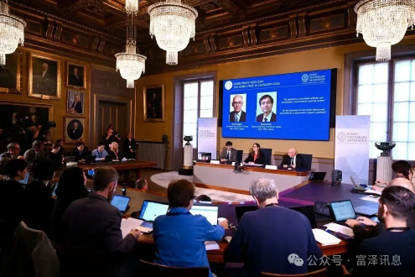
The 2026 Nobel Prize in Chemistry announcement scene was photographed in Stockholm, Sweden, on October 7
The molecular "key" has its "left and right"
When we bring our hands together, the outlines of both hands can be pressed together, but no matter how we flip them, they cannot fully coincide. Some molecules also have this kind of "left-right division," where they are mirror images of each other but cannot be flipped and overlap. Chemists call this property chirality. Here, "left" and "right" are metaphors to help understand spatial shapes.
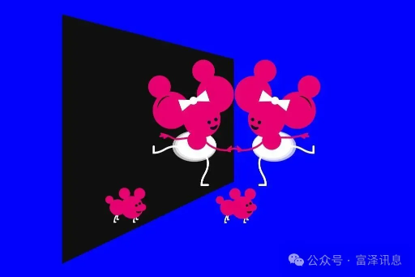
Image source: Nobel Prize official website; this is a schematic diagram of handiality
The difference in the mirror image of the molecular world is sometimes hidden in a wisp of smell. For example, one mirror isomer of carvone smells like mint in toothpaste, while another smells like caraway. Their atomic composition is the same, but their spatial arrangement cannot overlap. At the Nobel Chemistry Prize press conference on the 7th, Nobel Chemistry Committee chair Heiner Link explained that the nose can detect this difference because the receptors that recognize smells are also chiral, and they recognize the two mirror molecules differently.
What's the big deal about this spatial difference? Zou Xiaodong, a member of the Nobel Chemistry Committee, explained in an interview with Xinhua News Agency on the 7th that it's like wearing a glove on your right hand and a glove on your left—it's awkward—drug molecules interact with human proteins, and spatial structure must also be considered.
Key molecules in life systems, such as amino acids, also show a distinct chiral bias. Where does this "preference" of life come from? Meanwhile, chemists have a practical goal: to produce as many mirror molecules as needed as possible, rather than first obtaining two and then struggling to distinguish between them. So, they brought in chiral catalysts as "helpers"—not only to promote reactions but also to produce more of one mirror molecule.
But what if the "helpers" are also "mixed in the left and right"?
Let "helpers" amplify preferences
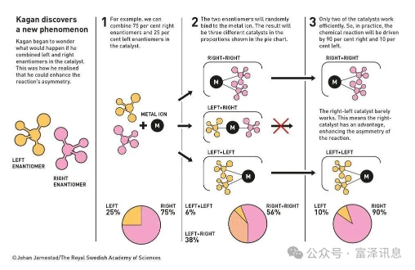
Image source: Nobel Prize official website. This is a schematic diagram of nonlinear effects in asymmetric chemical reactions discovered by Kagan
Initially, scientists believed that the chiral purity of the catalyst is linearly related to the chiral purity of the product. Therefore, to obtain the "key" to the highest possible chiral purity, researchers usually select "helpers" with high chiral purity.
But Kagan began to test a different approach: could the interaction of chiral molecules in the catalyst produce unexpected results?
A class of catalysts studied by Cargan consists of both metals and chiral molecules. He hypothesized that when two chiral molecules that are mirror images of each other are joined by metals, three combinations may be formed: "left-left," "right-right," and "left-right." If the "left-left" combination tends to produce "left" products, and the "right-right" combination tends to produce "right" products, how would the "left-right" combination work?
Experimental results show that the "left-right" combination catalyst drives chemical reactions much slower than the "right-right" or "left-left" combinations. Therefore, even if the "right" is only slightly more than the "left" at first, the advantage of the "right-right" combination is significantly amplified, meaning the product "amplifies" the bias in the catalyst.
In 1986, Kagan and colleagues reported a "nonlinear effect" between the chiral components of catalysts and the chiral purity of products. This discovery became an important breakthrough, attracting more chemists to explore the phenomenon and opening up new ideas for improving asymmetric reactions. Peter Schaumfoy, a member of the Nobel Chemistry Committee, said in an interview that these discoveries are "fundamental tools for designing and analyzing such reactions" when developing methods for synthesizing chiral drug molecules.
Let small advantages accumulate deeper and deeper
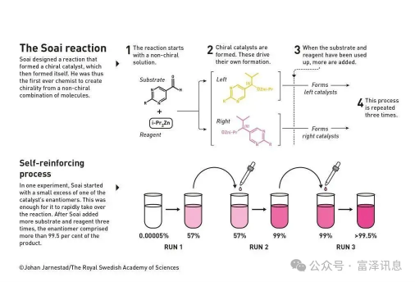
Image source: Nobel Prize official website. This is a schematic diagram of the asymmetric autocatalysis phenomenon discovered by Hsia Hexian III
However, amplifying the difference once is not the same as letting it keep expanding. Next, Xia Hexian 3 wanted to find a more unique response: to let newly formed molecules also become "helpers" joining the production line.
This is the basic idea of autocatalysis: the resulting material can also promote the raw material to become more of the same substance. If newly formed "right" molecules are better at helping produce "right" molecules, will the originally tiny proportional advantage grow larger and larger?
As early as 1953, physicist Charles Frank proposed a model: if one mirror molecule can both promote its own formation and inhibit the formation of another mirror molecule, then the initially small advantage may gradually increase.
By 1990, Xia He Xian III had achieved the inclusion of products in catalyzing their own formation, but the chirality purity of the products actually decreased. In 1995, he and his colleagues achieved a key breakthrough: the product not only continued to act as an "assistant," but also allowed the previously dominant mirror molecule to further increase the proportion of the mirror molecule.
In 2003, he went further with what would later be called the "coolest organic chemistry experiment"—the "paddle fusion reaction": starting from a non-chiral reactant, two chiral molecules were produced during the reaction. Whichever initially had a slight advantage would ultimately account for as much as 99.99% of the product.
Today, the discoveries of the two laureates have become important tools for understanding and designing asymmetric synthetic reactions, widely applied in organic synthesis and drug development. But this does not mean the mystery of life's chiral bias has been solved, as Xia He Xiansan said, "This is certainly not the final answer."
From hands that can't fully overlap, to a faint scent at the tip of the nose, to the tiny differences in the test tube, the "left and right" of molecules connect daily life and ancient questions about life. Where does life's "preference" come from? The answer unfolds in these subtle details.
Wu Xi Further Pharmaceutical Co.,Ltd
Main Products
Palmitoylethanolamide(PEA) Micro (CAS 544-31-0)
Spermidine trihydrochloride(CAS 334-50-9)
Pterostilbene(CAS 537-42-8)
Luteolin (CAS 491-70-3)
Voglibose (CAS 83480-29-9) JP GMP
Mailbox:wuxifurther@gmail.com
Whatsapp:+86 18036885286


