
Heparin, as the most widely used anticoagulant drug globally, has a direct impact on the quality and safety of patients' lives and health. However, the production and supply chain of heparin is complex, with diverse sources of raw materials (such as pig, cow, sheep and other animal intestines or lung tissues). During the production process, other glycosaminoglycans (such as dermatan sulfate and chondroitin sulfate) or non target components (such as DNA/RNA) may be mixed in, and even global crises have been triggered by pollution events (such as the "OSCS pollution incident" in 2008). How to control the quality of heparin from the source? Nuclear magnetic resonance (NMR) technology, with its high resolution, non-destructive and multidimensional analysis capabilities, has become a key tool for solving this problem.
Further Pharma in china focuses on the research and quality control of heparin drugs, including one-stop pharmaceutical technical services such as structural analysis, process optimization, impurity preparation, and quality research.
1、 How does NMR "see through" the complex structure of heparin sodium?
It utilizes the behavior characteristics of atomic nuclei in a magnetic field, especially their spin and magnetic moment, to reveal the connection and spatial arrangement between atoms inside the molecule by applying radio frequency pulses and detecting their response. For heparin sodium, a biomacromolecule with a complex sugar chain structure, NMR technology can accurately analyze its primary structure (i.e. the sequence of the sugar chain), secondary structure (such as the conformation of the sugar ring), and even tertiary structure (overall spatial configuration), providing detailed structural information for quality control.
Specifically, NMR technology can determine the chemical environment of hydrogen and carbon atoms at different positions in heparin sodium molecules through experiments such as 1H NMR and 13C NMR, and then infer the connection mode and sequence of sugar chains. In addition, the application of two-dimensional NMR techniques such as COSY, TOCSY, HSQC, and HMBC greatly enhances the ability of NMR technology in complex structure analysis, enabling researchers to gain a deeper understanding of the fine structure of heparin sodium molecules.
Heparin is a highly sulfated glycosaminoglycan (GAG) composed of alternating units of glucosamine and glucuronic acid. The sulfation sites and degree of acetylation vary depending on the source. These subtle structural differences directly affect the activity and safety of drugs. Although traditional detection methods such as high-performance liquid chromatography can separate impurities, they are difficult to fully analyze the molecular structure. NMR technology achieves precise analysis at the molecular level through the following methods:
Signal fingerprint recognition
NMR can capture unique signals of different functional groups in heparin molecules. For example:
1. Acetyl region (2.0-2.1 ppm)
Distinguish between heparin (2.05 ppm), dermatan sulfate (2.08 ppm), and chondroitin sulfate (2.02 ppm).
2. Heteromeric proton region (4.9-5.7 ppm)
Identify sugar units with different sulfation modes (such as IdoA2S, GlcNS6S). By comparing the NMR spectra of 88 crude heparin samples, researchers found significant differences in impurity content and sulfation modes among different samples (Figure 1.).
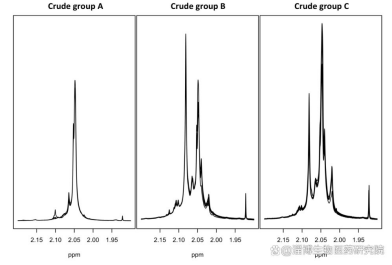
Figure 1.1H-NMR spectra.Acetyl region of proton spectra of samples of group A,group B,and group C registered at 600 MHz,showing methyl signals of Dermatan(2.08 ppm),Heparin(2.05 ppm),and Chondoritin(2.02 ppm)components.
Quantitative HSQC technology
Two dimensional heteronuclear single quantum coherence spectroscopy (HSQC) can quantitatively analyze the monosaccharide composition and sulfation degree of heparin. For example:
1. Calculate the ratio of N-acetylation to N-sulfation of glucosamine.
2. Detect the level of 6-O-sulfation (closely related to anticoagulant activity).
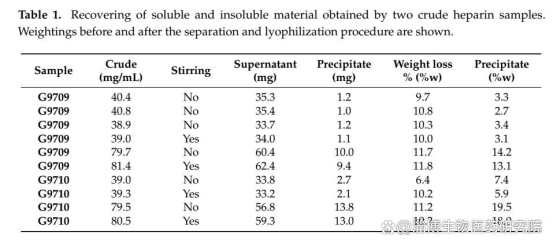
Research has shown that there are significant differences in the sulfation mode and acetylation degree of heparin from different animal sources (such as pig mucosa and cow lung) (Table 1), providing key evidence for traceability and quality control.
2、 Chemometrics: An Intelligent Assistant that Speaks Data
How can the massive NMR data generated during the analysis of the complex structure of heparin sodium be efficiently analyzed and utilized? This is where chemometrics shines brightly. Chemometrics, as an interdisciplinary field that applies mathematics, statistics, and computer science to the field of chemistry, provides powerful tools and methods for the analysis of NMR data. By applying chemometric algorithms to NMR data, researchers can automatically identify and extract key structural information, such as the connection mode of sugar chains, sulfate sites, and degree of acetylation. This not only greatly shortens the time for data analysis, but also improves the accuracy and reliability of the results.
In addition, chemometrics can also help establish a correlation model between the structure and mass of heparin sodium. Through statistical analysis and machine learning of NMR data from a large number of samples, researchers can reveal the intrinsic relationship between structural differences and drug activity and safety, providing a more scientific basis for the quality control of heparin sodium. In practical applications, the combination of chemometrics and NMR technology has achieved significant results. For example, researchers have successfully identified structural differences in heparin sodium from different sources using this technology platform, providing strong support for traceability and quality control. At the same time, the technology platform has also demonstrated broad application prospects in impurity detection and purity evaluation of heparin sodium.
Faced with massive NMR data, chemometric methods such as principal component analysis (PCA) convert complex spectra into visualized results, helping to quickly classify samples:
1. Purity grading
Distinguish high-purity samples (containing a small amount of impurities) from samples containing a large amount of sulfated dermatan or DNA using PCA (Figure 2).
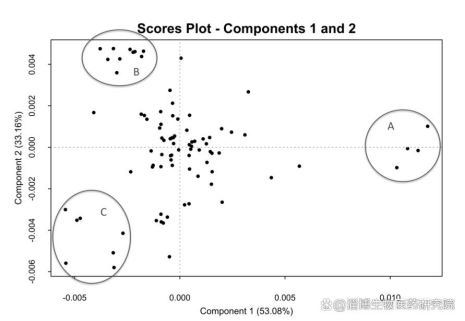
Figure 2.Score plot of the first two components generated by principal component analysis(PCA)of the GAGs signals region of the 1H-NMR spectrum.Most of the samples are centered in the PCA,while there are 21 more peripheral samples:highlighted as A,B,and C.
2. Traceability analysis
By analyzing only the region of anomeric protons, heparin from pig, cow, and sheep sources can be distinguished, and unexpected sources of doping can be accurately identified.
This "data-driven" strategy not only improves analysis efficiency, but also provides a scientific basis for developing quality standards for crude heparin.
3、 From Laboratory to Production Line: The Practical Value of NMR
NMR technology also plays an indispensable role in the production process of heparin sodium. From the screening of raw materials to the quality control of finished products, NMR technology can provide accurate structural information, ensuring that every step meets strict quality standards.
During the raw material screening stage, NMR technology can quickly identify and remove raw materials containing impurities or structural abnormalities, ensuring smooth production in the future. By comparing the NMR spectra of different batches of raw materials, researchers can evaluate their consistency and select materials with stable quality for production.
During the production process, NMR technology can also monitor the reaction progress and changes in product structure in real time. For example, in the sulfation process of heparin sodium, NMR technology can detect the degree of sulfation and changes in sulfation sites, ensuring that the product meets the expected structural requirements. Meanwhile, NMR technology can also be used to detect potential by-products or degradation products during the production process, providing important basis for optimizing production processes.
Finally, in the quality control stage of the finished product, NMR technology can comprehensively analyze the structure of heparin sodium, ensuring that it meets the quality standards specified in the pharmacopoeia. By comparing the NMR spectra of different batches of finished products, researchers can evaluate their inter batch consistency, thereby ensuring the stability and reliability of product quality.
In addition, NMR technology also has high reproducibility and transferability, which means that the structural information obtained using NMR technology is consistent across different laboratories or production lines. This provides strong support for the global production and quality control of heparin sodium.
In summary, nuclear magnetic resonance (NMR) technology, as the "golden eye" for the structural analysis and quality control of heparin sodium, plays a crucial role in ensuring the quality of heparin sodium drugs and ensuring patient medication safety. From the laboratory to the production line, NMR technology has demonstrated its unique practical value and application prospects.
1. Early quality control
Crude heparin is a precursor of heparin API, but its composition is complex and lacks a unified standard. NMR technology can quickly screen for impurities (such as chondroitin sulfate and DNA) before purification, preventing contamination from entering subsequent processes and reducing production risks.
2. Addressing supply chain challenges
The global heparin supply chain involves the collection and processing of raw materials from multiple countries. NMR combined with PCA can trace the source of raw materials, prevent the mixing of non target animal tissues (such as cattle and sheep), and ensure that the product meets regulatory requirements.
3. Promote standard upgrading
The NMR detection scheme proposed in the study has been included in some pharmacopoeia standards and is expected to become the "gold standard" for global heparin quality control in the future.
4、 Outlook: The Future Potential of NMR Technology
With the continuous development of technology, nuclear magnetic resonance (NMR) technology is used for the structural analysis and quality control of heparin sodium.
References:Mauri,L.et al.(2017).Combining NMR Spectroscopy and Chemometrics to Monitor Structural Features of Crude Heparin.Molecules,22(7),1146.
Wu Xi Further Pharmaceutical Co.,Ltd
Main Products
Palmitoylethanolamide(PEA) Micro (CAS 544-31-0)
Spermidine trihydrochloride(CAS 334-50-9)
Pterostilbene(CAS 537-42-8)
Luteolin (CAS 491-70-3)
Voglibose (CAS 83480-29-9) JP GMP
Mailbox:wuxifurther@gmail.com
Whatsapp:+86 18036885286


